The Nigeria–Cameroon Couple: A Geoeconomic Partnership for Shared African Prosperity
By Gergino, November 2025
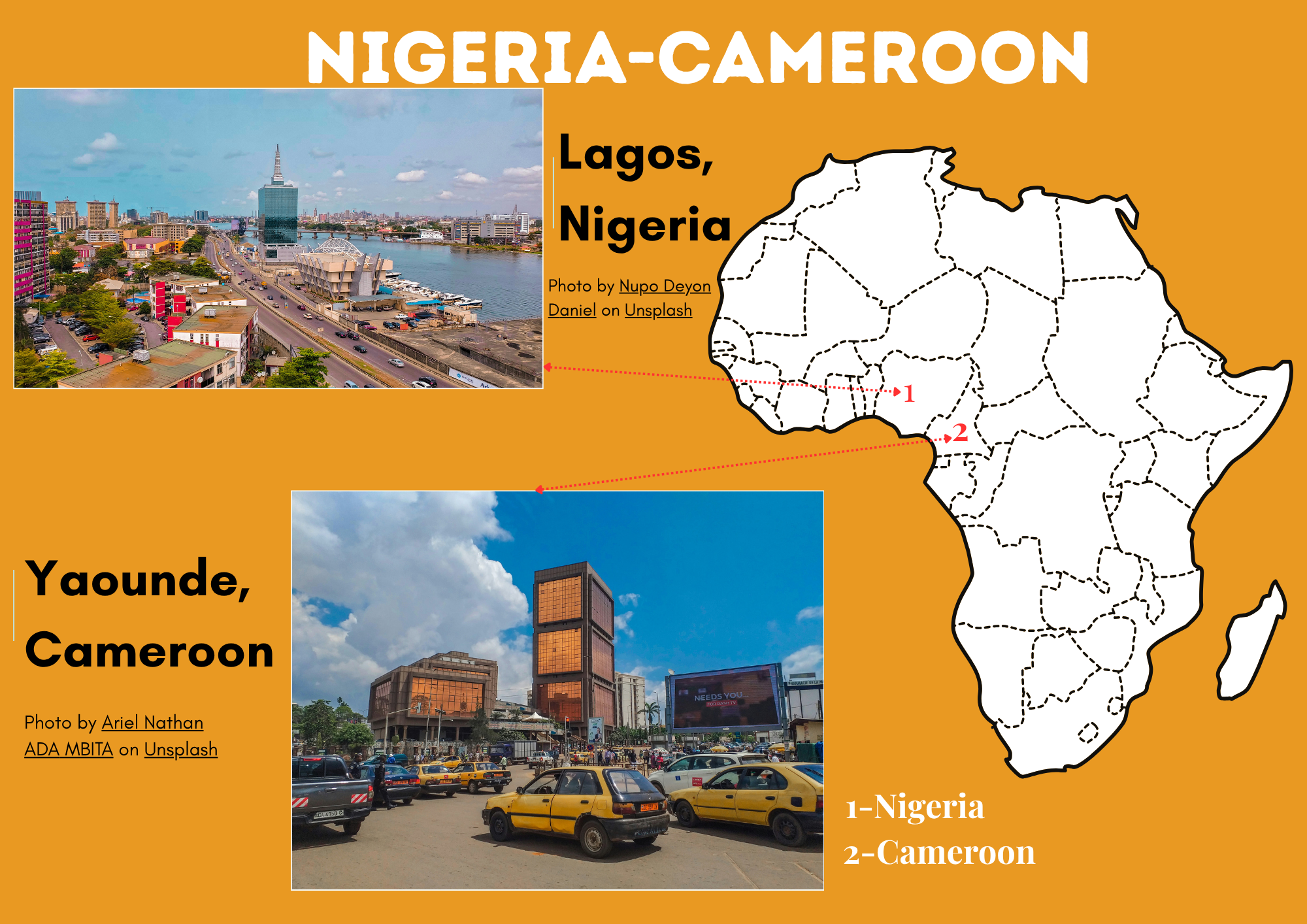
According to Tim Marshall, author of Prisoners of Geography, Geography is the destiny of nations. I fully agree with this declaration. If you do as well, you will also see that Nigeria’s geography positions it as the nation best placed to drive sub-Saharan African prosperity and development. As a Cameroonian, I often say that Cameroon has two most important and highest mountains. The first is Mont Cameroon (4100 m tall), along the Cameroon volcanic line running from the Atlantic Ocean to the Adamaoua region. The second is Nigeria, combining the continent’s largest population, second-largest economy, and the brightest economic perspectives for 2070, according to Goldman Sachs. My central argument is this: Nigeria’s economic scale and geography make it the leading driver of Sub-Saharan Africa’s growth, and countries like Cameroon risk missing out on prosperity if they do not build strong partnerships with Nigeria. Forming such ties is essential for accelerating shared economic growth and answering the fundamental question facing all Africans: how can we live with dignity, happiness, and harmony within Africa?
As of 2025, Nigeria has an estimated population of around 237.5 million people (Worldometer, 2025). The broader Sub-Saharan Africa region, which includes all African countries located south of the Sahara Desert, has a total population of about 1.24 billion people (United Nations Data, 2025; World Bank, 2024). This means that Nigeria alone accounts for roughly 19% of the entire Sub-Saharan African population, a remarkable demographic concentration within a single nation. If we exclude South Africa, then Nigeria represents 24% population. The implication of this is significant: Nigeria’s large population gives it substantial economic and political influence in the region, while also presenting major challenges in terms of providing adequate infrastructure, education, and employment for nearly one-fifth of Sub-Saharan Africa’s residents. So, Nigeria appears to me as an opportunity for other African nations, especially neighbouring countries with shared borders like Cameroon (1975 km), Chad (85 km), Niger (1608 km), and Benin (809 km), to create strategic partnerships, permitting them to connect their economies with that of Nigeria to foster shared prosperity. In addition, these countries can provide goods and services to the Nigerian population, keeping in mind that the population of Nigeria in 2070 will be around 430 million, nearly that of the whole European Union.
According to the International Monetary Fund (IMF), Nigeria’s nominal GDP is estimated at US$285 billion in 2025. Meanwhile, the total GDP for Sub-Saharan Africa is roughly US$1.86 trillion for 2024. This means that Nigeria’s economy accounts for around 15 % of the region’s output by nominal dollar value. Despite being one of the largest single-country economies in the region, Nigeria thus shares the burden of scaling growth, improving productivity, and addressing structural issues that affect the broader region. This includes low per-capita income, reliance on commodities, and limited industrial diversification. When measured by purchasing power parity (PPP), Nigeria’s GDP rises to about US $1.28 trillion, out of Sub-Saharan Africa’s US $6.7 trillion, representing nearly 19% of regional output (IMF, 2025). This shows that while Nigeria’s economy is large in aggregate terms, its income per person remains relatively low, reflecting structural issues such as overreliance on oil exports, slow industrial diversification, and high population growth. At the same time, this highlights both the potential of Nigeria as a major economic player in the region and the challenges of raising its contribution and performance relative to the region’s collective economic capacity.
When comparing Nigeria with neighbouring Cameroon, Nigeria’s economy is much larger overall, mainly due to its population and resources. However, Cameroon’s per-capita output is higher, so the average Cameroonian produces more economic value than the average Nigerian. Forecasts show Cameroon might grow slightly faster in percentage terms, but in absolute dollar value, Nigeria’s increase will be much greater. Nigeria's challenge is how to use its large scale to increase productivity and income per person, while Cameroon must expand its smaller economy and spread its current benefits more widely. Given Nigeria’s potential to be among the ten largest global economies by 2070, regional neighbours must partner with Nigeria for inclusion in future prosperity. Unfortunately, many countries are missing this opportunity by not taking decisive action.
It’s amazing to see that the GDP of the state of Lagos alone (one of the Nigerian states) overtakes that of 90% of African countries. As of 2025, Lagos State, Nigeria’s commercial capital, has an economy that rivals or even surpasses that of entire countries. According to recent estimates, Lagos’s Gross Domestic Product (GDP) stands at approximately US $259 billion (PPP), making it the second-largest city economy in Africa, behind Cairo. In contrast, the Republic of Cameroon has a national GDP of about US $56 billion (nominal) (World Bank, 2024; IMF, 2025). This highlights the disparity between Nigeria and Cameroon. On the other hand, Cameroon can use this disparity as an opportunity for its population by extending collaboration on technology sharing and implementation of joint ventures.
From the industrialisation perspective, Nigeria has made more visible strides in industrialisation than many other parts of Sub-Saharan Africa, yet it continues to face challenges typical of the region. On one hand, Nigeria’s manufacturing and industrial sectors have expanded over the past decades, with firms in food processing, textiles, cement, and consumer goods increasing their output (Chete et al., 2016). The country also hosts large industrial projects and several special economic and free-trade zones designed to strengthen heavy industry and promote value-added production (Brookings Institution, 2016). On the other hand, industrialisation across Sub-Saharan Africa remains limited, since the region’s share of global manufacturing output is less than 2%, and most countries still rely heavily on primary commodities such as oil, minerals, and agriculture (ODI, 2016). However, the industrial experience so far displayed by Nigeria can therefore be a mirror for broader regional patterns of moderate progress, which are often constrained by inadequate infrastructure, unreliable power supply, and limited technological upgrading (Brookings Institution, 2016).
When focusing on the energy sector, it’s observed that Nigeria’s energy sector stands out in Sub-Saharan Africa for its vast resources but also for its persistent structural challenges. Nigeria possesses the largest oil and gas reserves in Africa and remains one of the continent’s top crude oil producers (International Energy Agency [IEA], 2023). However, despite this abundance, electricity access and reliability remain low, with only about 40% of Nigerians enjoying consistent electricity supply, and most households still depend heavily on traditional biomass for cooking and heating (MDPI, 2024). This is a great challenge for his development, especially in the era of a net-zero carbon transition economy. Across Sub-Saharan Africa, similar patterns are observed. The region relies on traditional biomass for around 43% of total energy consumption, and fossil fuels continue to account for about 80% of total electricity generation (International Renewable Energy Agency [IRENA], 2022). Nevertheless, Nigeria performs relatively better than many of its neighbours in urban electrification rates and in attracting investment for renewable and gas-based power generation (IEA, 2023). Overall, Nigeria leads the region in energy potential and scale, yet its energy sector still reflects the broader Sub-Saharan African challenges of infrastructure deficits, low access to modern energy, and overdependence on non-renewable fuels. When comparing with Cameroon, Cameroon demonstrates a more sustainable energy mix, relying heavily on renewables. Though both nations struggle with infrastructure deficits and unreliable electricity access, it highlights that energy resource wealth alone does not ensure efficient or equitable energy delivery. However, the largest hydroelectric potential of Cameroon, including its solar potential in the northern regions, if well exploited, can be a source of energy for Cameroon's industrial development and can contribute to the creation of an energy partnership with Nigeria. Thereby fostering development for both Cameroon and Nigeria.
Having a look into the economic and commercial exchanges between Nigeria and Cameroon, we observed that there is substantial but remains asymmetrical and largely informal. In 2023, Nigeria’s exports to Cameroon were valued at approximately US $169 million, consisting mainly of steam turbines, scrap vessels, and refined petroleum products (Observatory of Economic Complexity [OEC], 2024). While Cameroon’s exports to Nigeria totalled around US $65.5 million, with goods such as agricultural products, raw materials, and manufactured items contributing to the trade balance (Trading Economics, 2024). Much of this exchange occurs through the shared border regions, where Nigeria serves as the primary supplier for western and northern Cameroon. This accounts for nearly 43% of imports in Cameroon’s Far North region (United Nations Development Programme [UNDP], 2023). However, despite these linkages, informal trade and security challenges along the border continue to hinder smooth commercial activity. Recurrent border closures, insurgency threats, and smuggling have disrupted formal trade flows and increased transaction costs (Institute for Security Studies [ISS], 2023). Even though Nigeria provides a vital market and trade route for Cameroon, the relationship remains uneven, with informal cross-border trade still overshadowing the limited formal economic exchange between the two countries. But here, Cameroon leaders and intellectuals must be critical enough against themselves not to see the US $169 million of Nigeria’s export as being very large, but the real question is how they can increase their export to Nigeria from US $65.5 million to US $169 million and beyond. Note that product exchange is not the only form of economic cooperation between neighbouring states.
Ending this writing, we continue to believe in the potential of Nigeria as the driving force of Sub-Saharan countries. Nigeria’s geographical position, demographic weight, and economic potential make it a pivotal actor in shaping the future of Sub-Saharan Africa. Nigeria’s natural resources and vast population of over 237 million people position it as a natural engine for regional prosperity. With an economy representing nearly 15% of Sub-Saharan Africa’s total GDP and projected to become one of the world’s top ten economies by 2070, Nigeria embodies both opportunity and responsibility for the continent’s growth. Realising this potential requires overcoming deep-rooted challenges such as infrastructure deficits, energy inefficiencies, and limited industrial diversification. Neighbouring countries like Cameroon stand to benefit immensely from deeper economic integration with Nigeria. Nigeria's large domestic market and industrial base can catalyse regional trade and technological advancement. While Cameroon’s economy is smaller, its more balanced energy mix and renewable potential offer complementary strengths that could support joint development strategies, particularly in sustainable energy and industrial production. Yet, bilateral trade between Cameroon and Nigeria remains modest and heavily informal. This is hindered by weak institutional cooperation and border insecurity, such as Boko Haram in Northern Cameroon, and the Anglophone crisis in the West regions.
In this regard, strengthening economic ties through energy partnerships, trade facilitation, educational and research exchange, and industrial collaboration could help both nations move toward shared prosperity and resilience. Overall, Nigeria’s destiny as a driver of Sub-Saharan African development is not predetermined by its geography alone but must be driven by the political will and strategic partnerships it forges with its neighbours. If nations like Cameroon seize the opportunity to align with Nigeria’s rise, they can collectively advance Africa’s long-sought goals of dignity, economic prosperity, and harmonious development, aiming to achieve the AU Vision of Africa 2063. Therefore, we, African leaders of tomorrow, need critical thinking, imagination, patience and integrity to create such an amazing vision.
References
- African Development Bank (AfDB). (2024). Cameroon Economic Outlook 2024. https://www.afdb.org/en/countries-central-africa-republic-cameroun
- Brookings Institution. (2016). Industrial development and growth in Nigeria: Lessons and challenges. https://www.brookings.edu/wp-content/uploads/2016/07/l2c_wp8_chete-et-al-1.pdf
- Chete, L. N., Adeoti, J. O., Adeyinka, F. M., & Ogundele, O. (2016). Industrial development and growth in Nigeria: Lessons and challenges. Brookings Institution Africa Growth Initiative.
- International Energy Agency (IEA). (2023). Nigeria Energy Profile 2023. https://iea.blob.core.windows.net/assets/c0cba412-d48c-4712-9144-48f93bd9e277/CountryProfileNigeria.pdf
- International Monetary Fund (IMF). (2025). World Economic Outlook Database, April 2025. https://www.imf.org/en/Publications/WEO
- International Renewable Energy Agency (IRENA). (2022). Renewable Energy Market Analysis: Africa and its Regions – Summary for Policy Makers. https://www.irena.org/-/media/Files/IRENA/Agency/Publication/2022/Jan/IRENA_Market_Africa_2022_Summary.pdf
- Lagos State Government. (2025). Lagos GDP hits ₦66.47 trillion in 2025 projection. https://lagosstate.gov.ng
- MDPI. (2024). Energy Access and Sustainability Challenges in Nigeria. Sustainability, 16(20), 8803. https://www.mdpi.com/2071-1050/16/20/8803
- Nairametrics. (2025). Lagos GDP hits $259 billion, ranks as Africa’s second-largest city economy. https://nairametrics.com
- Overseas Development Institute (ODI). (2016). Supporting the transformation of African manufacturing. https://odi.org/documents/3616/6706.pdf
- United Nations Data. (2025). Region: Sub-Saharan Africa. https://data.un.org/en/reg/g202.html
- World Bank. (2024). Population, Sub-Saharan Africa (excluding high income) – World Development Indicators. https://data.worldbank.org/indicator/SP.POP.TOTL?locations=ZG
- World Bank. (2024). World Development Indicators – Cameroon. https://data.worldbank.org/country/cameroon
- World Bank. (2024). World Development Indicators – Sub-Saharan Africa. https://data.worldbank.org/region/sub-saharan-africa
- Worldometer. (2025). Nigeria Population (Live). https://www.worldometers.info/world-population/nigeria-population/